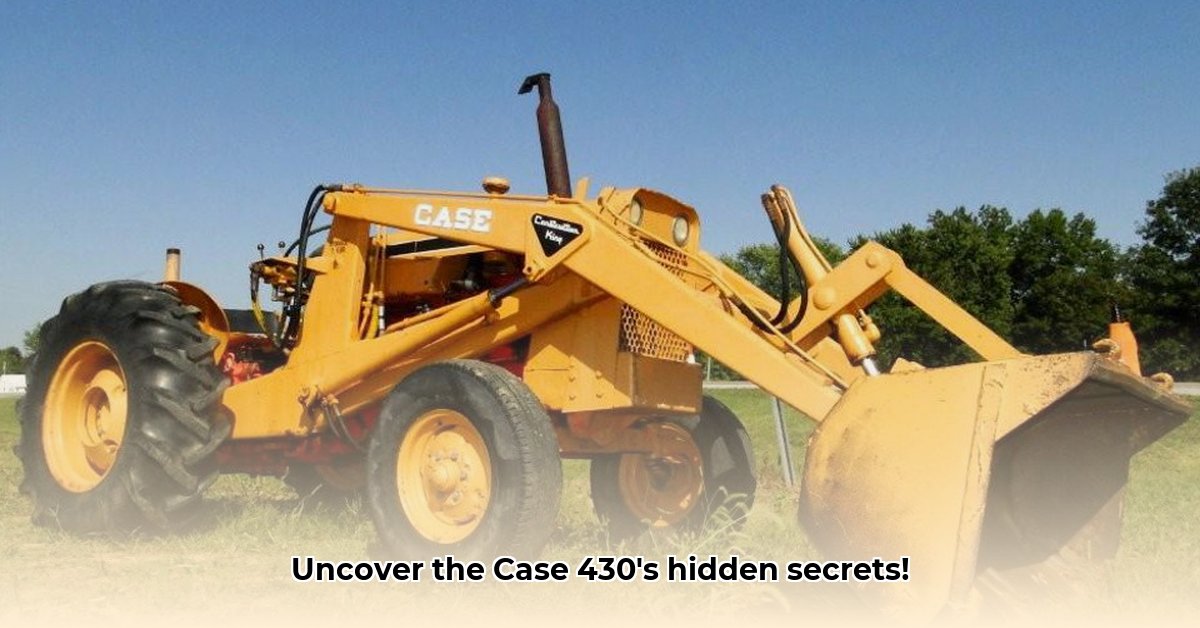
The Case 430 tractor, produced from 1960 to 1969, holds a significant place in agricultural history. This comprehensive guide delves into its specifications, performance characteristics, and historical context, providing valuable information for collectors, enthusiasts, and anyone interested in classic farm machinery. Understanding the Case 430's strengths and weaknesses—from its engine power to its transmission options—offers a glimpse into the evolution of agricultural technology. For even more detailed specs, check out this helpful resource: Case 430 Specs.
Under the Hood: The Case 430 Engine and Performance
The Case 430's power came from a robust four-cylinder diesel engine, boasting a displacement of 3.1 liters. Horsepower ratings varied slightly depending on the year and measurement method, typically ranging from 34 to 37.8 horsepower (HP). This variance, common in agricultural equipment of that era, highlights the less standardized testing methods of the time. While seemingly minor, these differences impacted the tractor's capabilities in various field applications. A few extra HP could prove crucial during demanding tasks, such as plowing heavy soil or hauling significant loads. This understanding sheds light on the practical considerations faced by farmers choosing equipment in the 1960s. What were the most impactful differences between the horsepower ratings for farmers?
Transmission Options: A Comparative Analysis
The Case 430 offered a choice of transmissions, each impacting operational efficiency and ease of use. These options, ranging in complexity, reveal an evolution in design focused on adapting to differing operator needs and farming styles.
| Transmission Type | Forward Gears | Reverse Gears | Operator Experience |
|---|---|---|---|
| 4-Speed | 4 | 1 | Simple, easy to learn, but limited versatility. |
| 12-Speed Unsynchronized | 12 | 3 | High versatility, demanding precise shifting technique. |
| 8-Speed Mechanical Shuttle | 8 | 2 or 4 | Balanced approach, offering more gears without excessive complexity. |
The 12-speed unsynchronized transmission, while offering greater flexibility, required a skilled touch to avoid jarring shifts. This feature highlights the significant physical demands placed on operators of the era, compared to modern, synchronized transmissions found in today's tractors. What were the trade-offs for farmers choosing each transmission?
Model Variations: Tailoring to Farmer Requirements
Case offered several models within the 430 series (430, 431, 440, 441, 445), each with subtle differences catering to specific farming needs. These variations demonstrate the company's commitment to adaptability, providing choices to match diverse operational requirements. Minor variations in engine specifications and features like power take-offs (PTO) provided farmers with options to tailor their equipment to their exact needs.
A Legacy of Innovation: Gradual Improvements Over Time
The Case 430 wasn't a static design. Significant improvements were incorporated during its ten-year production run (1960-1969). The introduction of power steering in 1965 marked a significant leap in operator comfort, reducing fatigue and increasing maneuverability. The optional independent PTO, added in 1966, further enhanced the tractor's versatility, expanding its capabilities beyond basic plowing and hauling. These enhancements underscore Case's responsiveness to user feedback and their commitment to continuous improvement.
Safety Considerations: A Historical Perspective
Assessing the Case 430 through the lens of modern safety standards reveals some significant differences. The open operator station lacked the protection offered by modern cabs, exposing the operator to the elements and potential hazards. The unsynchronized transmissions, while offering varied gear ratios, demanded greater operator skill and contributed to physical fatigue. These factors underscore the evolution of safety features in agricultural machinery over time.
The Enduring Appeal of the Case 430
The Case 430 remains a popular machine among collectors and enthusiasts, reflecting its role in agricultural history and the robust quality of its design. Its enduring appeal is a testament to its practical design, reliability, and historical significance. Its influence on subsequent tractor designs is undeniable. It remains a symbol of a bygone era of farming. Why do you think the Case 430 maintains such a strong following?
Case 430 Restoration: A Practical Guide
Restoring a Case 430 is a rewarding but challenging undertaking. Success hinges on careful planning, sourcing parts, and a methodical approach. The availability of parts is a common hurdle, with certain components proving difficult to locate. Online forums and specialty suppliers are crucial resources for securing both original and reproduction parts.
Key Steps in Restoration:
- Comprehensive Assessment: Conduct a thorough inspection to correctly gauge the extent of required repairs.
- Meticulous Disassembly: Document each step of the disassembly process for accurate reassembly.
- Thorough Cleaning: Clean and degrease all parts thoroughly to prepare for inspection and repair.
- Targeted Repairs: Repair or replace components as necessary, prioritizing critical systems.
- Precise Reassembly: Carefully reassemble the tractor, adhering to the original manufacturer's specifications.
- Rigorous Testing: Thoroughly test all systems before operation to ensure safety and proper functionality.
The successful restoration of a Case 430 is a significant accomplishment; a testament to both the tractor's enduring design and the restorer's skill and dedication to preserving agricultural history.